

AI Makes Execution Cheaper. Judgment Becomes the Advantage
There is a lot of discussion right now about whether AI will replace designers, but I think a more interesting question sits underneath that debate. What happens when execution becomes easier to produce, and how might that change what the market values?
That may be the real shift unfolding.
Tasks that once required significant time or specialized skill, from early interface exploration to prototyping, synthesis, and even front-end implementation, can increasingly be done faster with AI-assisted tools. That does not mean these activities no longer matter, nor does it mean craft has become irrelevant. It means something subtler: parts of execution that were once scarce may be becoming less scarce. And when scarcity changes, value often shifts with it.
1. AI Is Making Execution Cheap
I want to be precise about what I mean by “cheap,” because I do not mean worthless. Execution still matters, craft still matters, and strong implementation still matters. What I mean is that certain forms of production are becoming easier, faster, and more accessible than before.
For example:
- Wireframes can be generated in minutes
- Prototype ideas can be explored much faster
- Code can be scaffolded with far less effort
- Research synthesis can be accelerated
That is not simply a tooling improvement. It may be a structural change. When something becomes easier to produce, it often stops being the primary differentiator, and markets begin rewarding what remains scarce. That is why I do not think the important question is whether AI can help people execute faster. It clearly can. I think the more interesting question is what the market may increasingly reward when execution itself is no longer where advantage primarily lives.
2. When Execution Gets Cheap, Judgment Becomes the Advantage
If execution becomes less scarce, then competitive advantage may move elsewhere. My view is that it moves toward the quality of decisions behind the work. Not simply the ability to produce outputs, but the ability to decide what should be made, why it should be made, how constraints shape the solution, and what tradeoffs matter.
That is what I mean by judgment. Not intuition or abstract creative instinct, but practical decision-making grounded in context. It includes problem framing, prioritization, contextual reasoning, and choosing well under uncertainty. These things may become more important when tools help many people generate outputs faster, because when output becomes abundant, the quality of decisions behind output may matter even more.
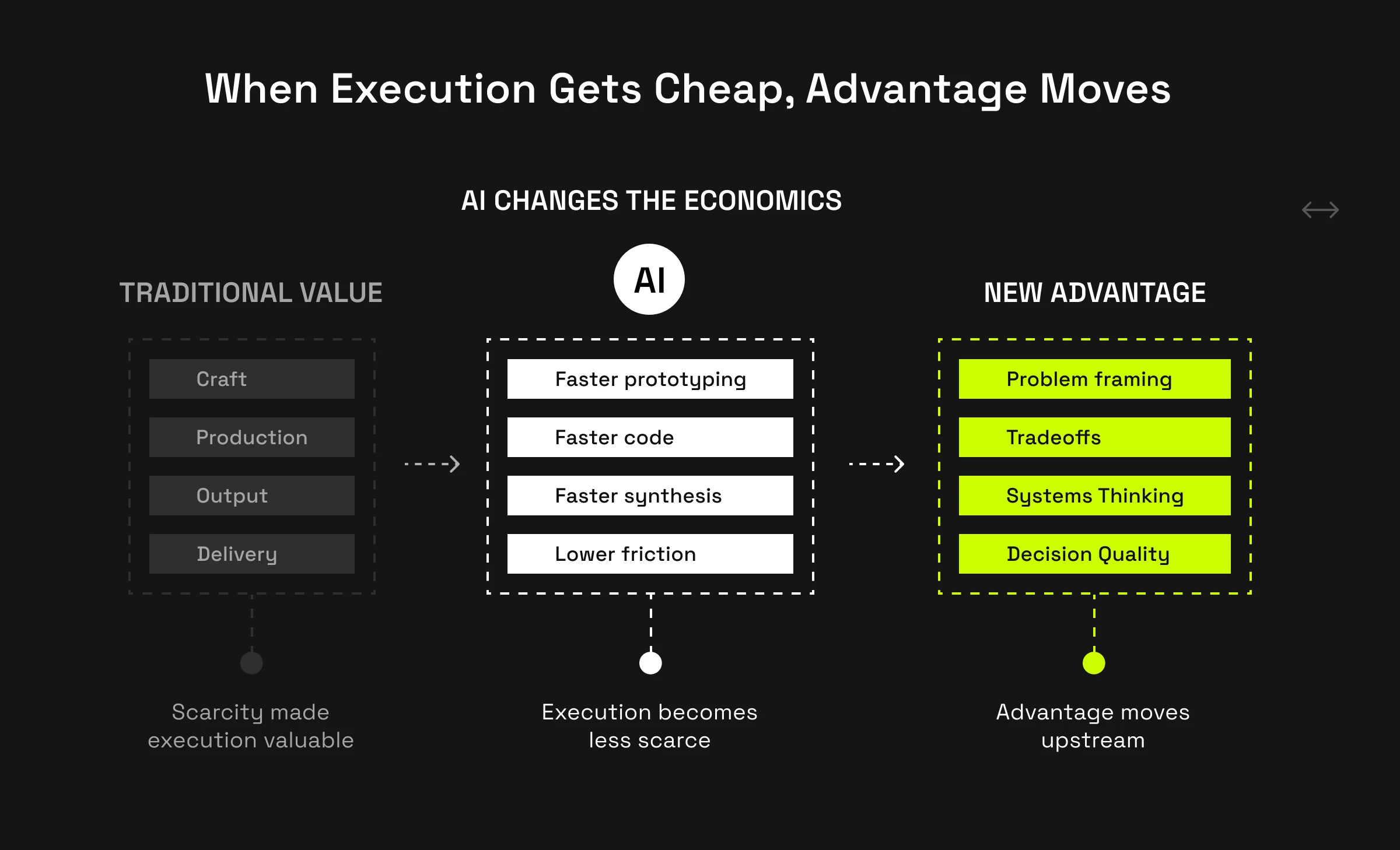
This is where I think many conversations about AI and design are slightly off. They often focus on whether tools can replicate execution, when the more important question may be whether better decision-making becomes a stronger differentiator than execution itself. That broader shift is reflected in how design and technology leaders are increasingly talking about AI as something that may elevate the importance of human judgment, not diminish it. John Maeda has made a particularly strong argument in this direction.
“IN A WORLD OF MORE AUTOMATION, HUMAN JUDGMENT MATTERS MORE, NOT LESS”
3. The Real Risk Is Confusing Speed With Value
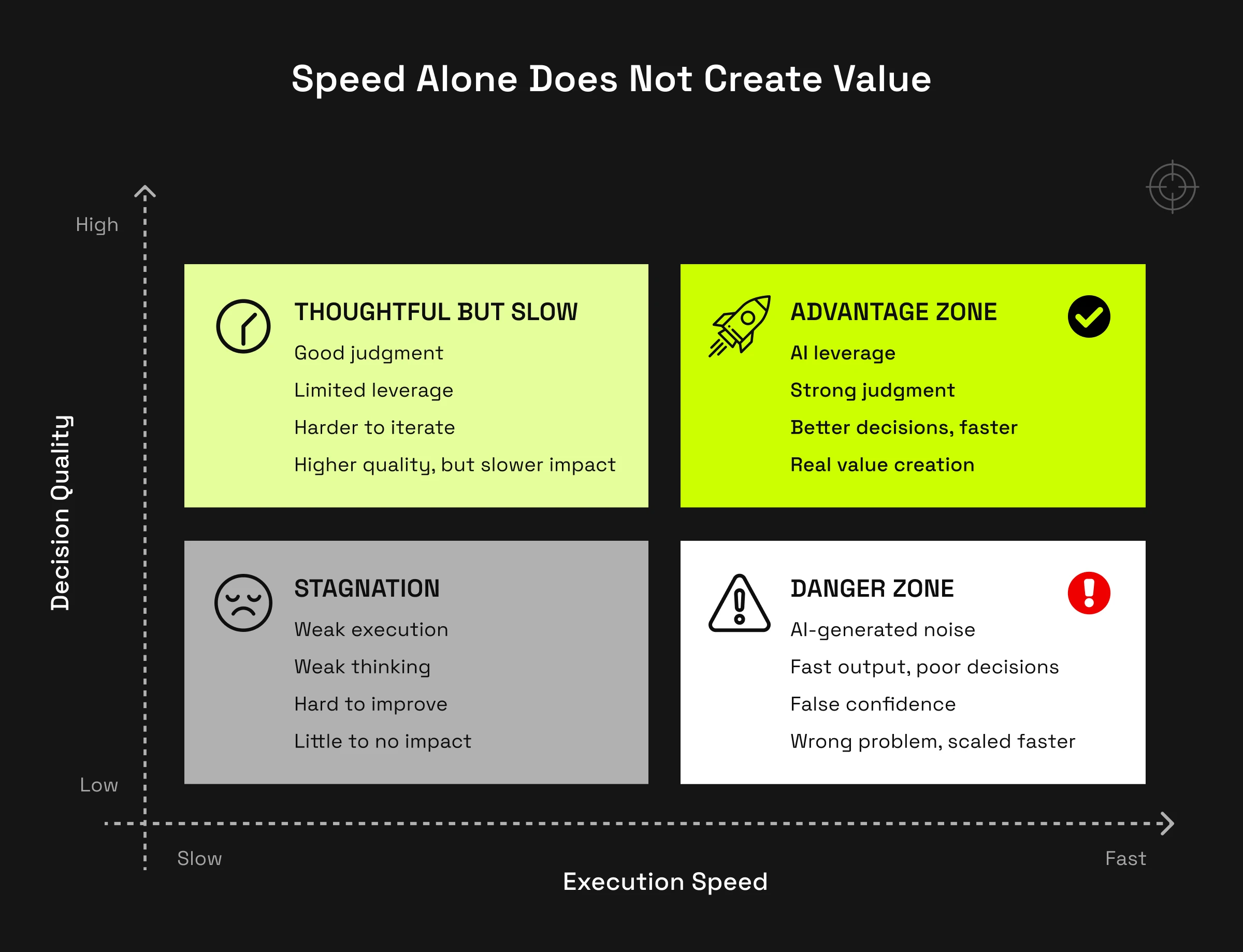
One of the easiest mistakes to make right now is to confuse efficiency with effectiveness. AI can increase speed, but speed does not automatically create value. Faster output does not guarantee better decisions, stronger products, or better outcomes. Those are different things, and I think that distinction matters more than people sometimes acknowledge.
Fast, polished output can create the illusion of quality while still being grounded in weak assumptions, shallow reasoning, or the wrong problem entirely. In some cases, AI may help scale noise as efficiently as signal, accelerating work that should not have been pursued in the first place. That is not a critique of AI. It is a reminder that speed alone is not strategy.
And I think this is where the conversation becomes much more interesting, because if speed is not the advantage, then what may be valued more going forward?
4. What Great Designers (and Great Companies) Will Be Valued For Now
My view is that the market may increasingly reward those who make better decisions, not simply those who produce faster outputs.
For designers, that may elevate capabilities like:
- Stronger problem framing
- Navigating tradeoffs
- Systems thinking
- Contextual judgment
- Responsible use of AI
The shift may be less about doing more, and more about doing better.
I think it applies beyond individual practitioners. Great companies may not be defined by adopting AI fastest, but by integrating it most thoughtfully: building better decision environments, combining human judgment with AI well, and understanding that while execution may accelerate, judgment may compound. That view aligns with how some product leaders are framing this shift as well. Dylan Field, for example, has argued that AI may raise standards rather than lower them.
“AI RAISES THE BAR. IT DOESN’T LOWER IT”
That matters because execution can improve efficiency, but judgment may improve outcomes across products, teams, and strategy. And that feels much closer to durable advantage. Some time ago, I wrote about hybrid thinking in design through the lens of code. I think this is related, but broader. The deeper question may not be whether designers should use more powerful tools, but what capabilities become more valuable as tools become more powerful.
5. AI Doesn’t Reduce the Need for Judgment. It Increases It.
This is where I land: I do not think AI reduces the importance of human judgment. I think it may increase the premium on it.
As AI expands, more options may be generated, more decisions may require evaluation, and more outcomes may still require human responsibility. That does not shrink the burden of deciding well. It may increase it.
And that is why I do not see AI as reducing human value in design. I see it changing where value may concentrate, possibly away from execution alone and more toward deciding well. That may be true for designers, for companies, and perhaps more broadly for how we think about expertise itself. In many ways, that echoes a point Julie Zhuo has made for years about where the real value of design actually resides.
“THE VALUE OF DESIGN HAS NEVER BEEN THE ARTIFACT ITSELF, BUT THE THINKING BEHIND IT”
If AI makes execution cheaper, judgment may not simply remain important. It may become the advantage. And in an AI-accelerated world, that may be what matters most.
I’d especially love to hear from hiring managers, founders, and design leaders: do you see judgment becoming a stronger differentiator as AI changes how work gets done?
RELATED WORK
Case Studies


A smart operationsplatform for homeservice businesses (SaaS)
Lead Product Designer & Design Engineer


Modern e-commerceplatform
Lead Product Designer & Design Engineer